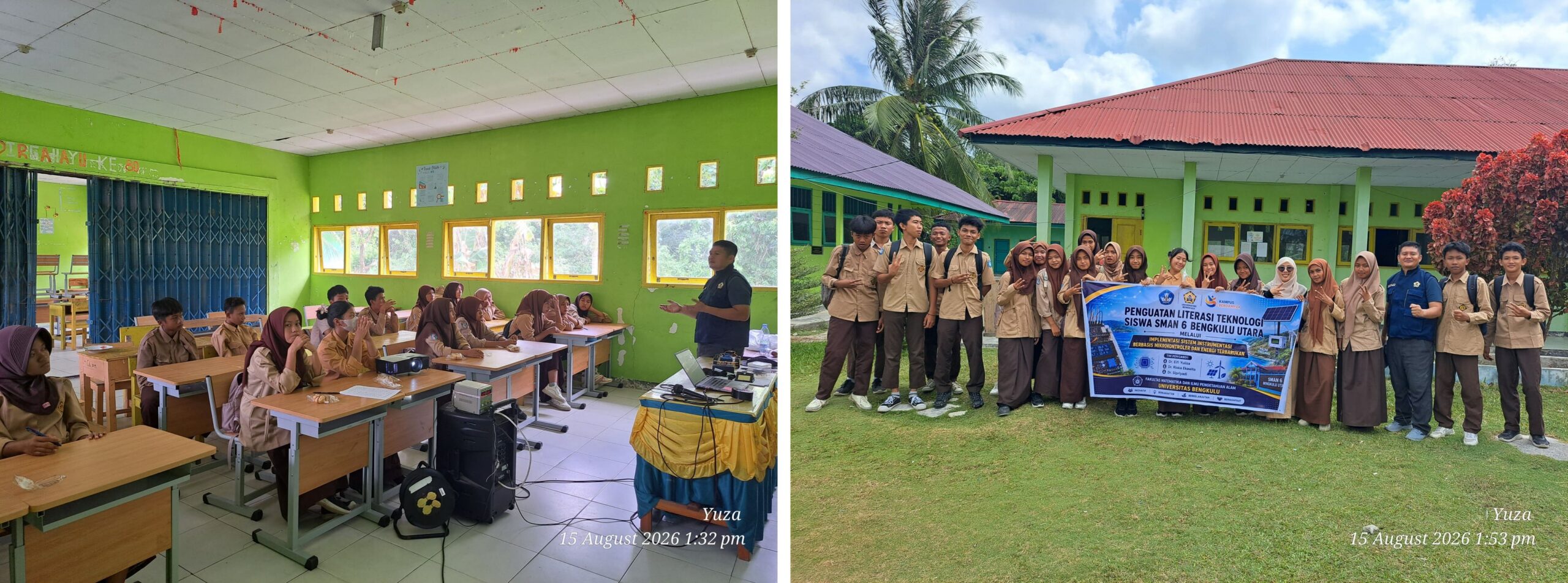
FMIPA Universitas Bengkulu Brings Technology Literacy and Renewable Energy Education to Students on Enggano Island
The Faculty of Mathematics and Natural Sciences (FMIPA), Universitas Bengkulu, conducted a community service program under the 2026 Futuristic Study Program Scheme with the theme “Technology Literacy and Renewable Energy.” The program was held at SMA Negeri 6 Bengkulu Utara, Enggano Island, Bengkulu Province, on August 15, 2026, with the aim of introducing students to technology, renewable energy, and the academic environment of higher education. Through this activity, the team sought to stimulate students’ curiosity about science and technology and encourage them to pursue further education after completing high school.
The program was carried out by a team from FMIPA Universitas Bengkulu consisting of Dr. Elfi Yuliza (Physics), Dr. Riska Ekawita (Physics), Dr. Sipriyadi (Biology) and students of Physics Study Program. The activity was motivated by the geographical and educational conditions of Enggano Island, one of the outermost islands of Bengkulu Province. Limited transportation access and the availability of teachers and educational resources present significant challenges for students on the island. SMA Negeri 6 Bengkulu Utara is the only senior high school on Enggano Island, making it an important institution for providing secondary education to students in the region. These conditions are also associated with relatively limited technology literacy and low interest in pursuing higher education among students.
The implementation of the program began with initial communication and coordination with the school through the Principal, Mr. Budiman Kauno, S.Pd. This was followed by the preparation and submission of the community service proposal, preparation of demonstration components and equipment at the Physics Laboratory of FMIPA Universitas Bengkulu, and coordination with the school to prepare the activity. The program was subsequently conducted at SMA Negeri 6 Bengkulu Utara on August 15, 2026, and was attended by 20 tenth-grade students. The students showed great enthusiasm throughout the activity. The program began with a presentation introducing technology literacy, renewable energy, robotics, and examples of student projects developed for various applications. The presentation was designed to demonstrate how science and technology can be applied to address real-world problems and how students can develop similar projects through learning and experimentation.
Following the presentation, the community service team demonstrated several prototypes brought to the school. The students were given the opportunity to participate in hands-on activities, allowing them to directly interact with and operate the equipment being demonstrated. This approach provided students with a more engaging learning experience and helped them understand that technology is not only something to be studied theoretically but can also be developed and applied to solve problems in their surrounding environment. The activity continued with an interactive question-and-answer session. The students actively asked questions about the technologies presented, how the prototypes were developed, and how they could learn more about technology and science. Their participation demonstrated a strong interest in the topics presented during the program.
In addition to technology literacy and renewable energy, the team introduced students to the university environment and career opportunities associated with science and technology. Students were introduced to the learning environment at Universitas Bengkulu, opportunities for higher education, and potential career paths related to science and technology. This component was intended to broaden students’ perspectives and encourage them to consider higher education as an important pathway for achieving their future goals.
The effectiveness of the activity was reflected in the students’ participation and responses to the evaluation questionnaire. The final questionnaire indicated an increase in students’ knowledge compared with their knowledge before the activity. Students also raised various questions about university life, study programs, and opportunities to continue their education. These responses indicate that the activity not only improved students’ understanding of technology and renewable energy but also stimulated their interest in higher education.
The school expressed its appreciation for the program and welcomed the opportunity to provide students with new knowledge and direct interaction with university lecturers. The school hopes that similar activities can be continued in the future and contribute to increasing students’ motivation to learn and pursue higher education, particularly for students living in remote and outermost areas. Held during Indonesia’s month of independence, the activity carried an additional message of educational equality and national development. The community service team hopes that increasing access to knowledge, technology literacy, and higher education information can contribute to more equitable development in Indonesia’s outermost regions, in line with the constitutional mandate of the 1945 Constitution of the Republic of Indonesia.
The FMIPA Universitas Bengkulu community service team expresses its gratitude to FMIPA Universitas Bengkulu for supporting the implementation of this program through the 2026 Community Service Funding under the Futuristic Study Program Scheme. Through continued collaboration between universities and schools in remote areas, such initiatives are expected to help inspire young people on the outer islands to learn, innovate, and pursue higher education for a better future.


